Friday, June 13, 2008

Ngaramtoni Football Tournament

May 30th 2008

During 2007, one of our supporters, Clive Berrington, did a fantastic job and raised more than £1000 to enable us to organise a football tournament in Ngaramtoni. Sport is a great way to help children develop team-working skills, as well as promoting creativity and physical fitness. Needless to say, the boys in Ngaramtoni are football obsessed and didn’t need much encouragement to get training for the event!

Our volunteer Jane Griffiths who was teaching at Kimnyak Primary got the ball rolling (quite literally!) at the beginning of the year. Then Andre Le Gouais arrived at Timbolo Primary in March and things really started moving. Andre and Samwel (one of the teachers at Timbolo) organised a match schedule, wrote out all the rules and league system, and invited Emaoi Primary, Kimnyak Primary, Sambasha Primary as well as Timbolo Primary to take part.

All of the schools were really excited and training started in earnest as well as some pre-tournament friendlies. In the mean time Andre and Samwel were hard at work searching out brand new kits for the teams and negotiating the best prices possible. As well as kits for each school, Clive’s money funded footballs for each school, a fantastic trophy, official referees and linesman from the Ngaramtoni Football Association and lunch and refreshments for all the players. And of course no football match would be complete without the half-time oranges!
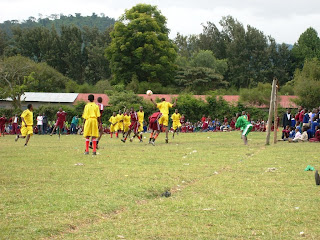
Thankfully, tournament day, Friday 30th May, was overcast and not the scorcher we were dreading! The teams looked fantastic in their new strips and I think we all had a lump in our throats as they lined up and sang the national anthem. The first part of the competition was a league system, with everyone playing each other. All 4 teams were closely matched and competition was fierce. There were some flashes of brilliance from individuals and some spectacular goals. These were accompanied by the obligatory pitch invasion. There were well over 1000 spectators, including the local village chairman who completely failed to be impartial, shouting loudly for Sambasha and criticising all their mistakes!

After a great few hours of football we were left with a final of Sambasha versus Kimnyak. We broke for a tasty lunch and then were back for the climax. By the end of the first half the teams were poised at nil – nil. David Kinisi then suggested putting the trophy on display (like for the World Cup) to give the boys that extra bit of encouragement. Well, it nearly caused a riot! There were hundreds of spectators crowding round it, I don’t think they had seen anything like it before. As the second half progressed we saw a few tired players, but we also saw 2 fantastic goals from Sambasha, as they finished deserved winners. They enjoyed their well-deserved lap of honour with the trophy with most of the teachers and spectators trailing behind. It was a really super day all round. We now have plans for a netball tournament later in the year and the boys have already started training for the next football tournament in September – any volunteers who want to help organise it are most welcome in Ngaramtoni!

Monday, May 26, 2008

Kighare Secondary - Usangi

John Reed April - May 2008

I’ve been in Tanzania for a month now and it is interesting reading my first blog to see how my opinions have changed. In many ways things are the same, friendly welcoming people, beautiful scenery, and wonderful hosts.
I can now beat Ali at drafts, which is apparently a major achievement. I didn’t tell him that I am a pretty good chess player but it took me ages to master the strange Tanzanian rules and a 10 by 10 board. Usangi still is a safe and secure place. One day I felt someone was following up the hill but it came to nothing.
Teaching the local ladies English was a lot of fun. They were great students and have excellent English accents. They just don’t seem to understand that 2 o’clock means 2 not 2.30 or 3.00! Songs go down well particularly 10 green bottles. Mr Ismaeli has introduced me to a lady of 110 years (her 3rd son was 75). I have gone on some lovely local walks and been greeted with endless good cheer. I know enough Kiswahili to explain that I am a teacher. This seems to satisfy local gossip needs.
My teaching is now finished as the examinations have started. Form 1 have been attentive and fun. All 70 plus of them work so hard. Taking a photo is hard but I have tried. Many of them have high ambitions which are great and many have the ability to succeed. My two forms 3 have been good with one or two off days. Teachers in the UK please note that these are not the same as off days in an English comp. It just means they weren’t all as committed as usual. Often the problem is that the start of the lesson so messy with the students coming in late from doing jobs. Their English is not as good as I thought and many of them have not good maths skills. The topic was functions (!!) so it was a challenge. Nevertheless many did well and responded to having their books regularly marked (with stickers) and also to me dashing round trying to help them.
The big cloud has been corporal punishment. It has now exceeded my wildest expectations and sometimes I have gone back to the volunteer house in shock. It seems uncontrolled, indiscriminate and violent. As the term has finished there has been a little bit of an ‘end of term’ feeling that characterises all schools, exacerbated by a shortage of and absence of staff. The reaction of some of the staff was not worthy of any teacher.
Apart from that I was concerned by the situation of the girls. The head is the only female teacher. During my time she has been absent about half of the days. There is no one for the girls to go and see apart from male teachers. Also that sense of restraint and good sense normally provided by female teachers is noticeably absent.
So I left after my teaching was over. Staying to supervise exams seemed fruitless. During all this time my support from Mondo Challenge has been endless, helpful and sensible.
This experience has been extraordinary, seeing a country from a perspective so far removed from that of a tourist. The people here live life little above a poverty level and work very hard. Age is not a limiting factor and grannies work from dawn to dusk doing hard physical labour. They are kind and generous and have high expectations for their children and of the education system. One can easily over romanticise the culture in such a beautiful setting but there are pluses over European life, almost no litter, non existent consumerism, a great feeling of community, wonderful hospitality and endless cheerfulness and laughter. The price is high, however in long days of work, lack of reading materials and limited ability to travel. It’s at least one hour to a metalled road. There is continued shortage of cash and an education system constrained by numbers, lack of teachers, and lack of good teachers.
The birth rate is very high. 7 or 8 children are normal in a family. I would guess the mountains may not sustain the increased population. The fragile infrastructure will struggle to keep up.I said goodbye to Mr Ismaeli and his wonderful family with regret and sadness. I beat Ali one last time at drafts before I left.

Monday, May 19, 2008

Longido Internet Centre


At the end of April we had a visit from our corporate volunters from Buro Four. Their company has invested a large amount of money into creating a fantastic Community Internet and Computer Centre, in partnesrship with Mondo and LOOCIP in Longido.

The centre is powered totally by solar panels and provides internet access for anyone in the community. LOOCIP have employed Godlove Masambaji (who some of you may remember from Usangi) as the centre manager, and together with Mr Engeresa from LOOCIP they have been working hard on bringing this resource to as many members of the community as possible. Computer skills training has started this week as well as sessions to learn how to use the internet.


B4 generously provided laptops and gave some computer training as well as setting up a network and giving some initial training. The idea is that the centre will be an educational resource for students, teachers, health workers, local NGOs and the community as a whole.


One of the highlights of the opening was a demonstration of Google Earth, starting with looking at houses in Longido itself and then gradually zooming out to see Tanzania, East Africa and the World.

As well as the internet centre the B4 volunteers worked on a rainwater harvesting pilot, installing tanks at homes in the village so help people during the dry season (which really lasts a long time in Longido).
There was lots of local interest and some local fundi are now being trained to build the tanks.
Overall, it has been an amazing few weeks in Longido - I'm sure some of our ex-Longido volunteers would be amazed to see it!! And of course karibuni sana!

Friday, May 9, 2008

Hope Trust - Ngaramtoni

Rachel Doyle April - July 2008
So many thoughts are going around in my head at the moment. It all seems a bit surreal sat here in my room listening to Ali Faka Toure on my laptop (Mali music) and typing away at my journal at 8am after breakfast and before I leave for the office. I left Arusha yesterday afternoon and took a taxi with Leonard the local man in the Mondo challenge office. We took a taxi to Ngaramtoni – a half hour ride through green fields of corn and bananas. As we drove through the village I was surprised at how busy it was with many shops and a couple of bars and cafes and lots of local activity. The village is mainly Maasai and although many of them now don’t wear the traditional red cloths there are still plenty dotted around. I met the family that I will be staying with for the next 3 months who consist of Mr David, Mama Baraka, Julius (approx 7) and Venance (approx 5). The family are Maasai but a modern Maasai family. Mr David owns the ‘New Sahara’ café in town and Mama Baraka works at the hospital as an anaesthetist. They are very welcoming and a lovely family. Mama Baraka showed me around the house, a brick built building which consists of 4 bedrooms – mine, the childrens, the housegirl and theirs, a lounge complete with sofas and a tv. The cooking is done outside in the courtyard and the toilet is also outside along with a shower cubicle. I have not sussed out the washing routine as yet – I get a bucket of hot water in the evening which is my ‘shower’ but the logistics of juggling my clothes and toiletries and trying not to get everything wet has yet to be mastered. The housegirl does all the domestic duties including the shopping, cooking, washing etc and looks after the children. My room consists of a bed, shelves a table and chair and cupboard and electricity which is a bonus. I have a surge protector that I bought yesterday as apparently the fluctuating electrics can damage your equipment. It is flickering all the time and I am making sure that I save my work regularly! Andre who is volunteering at a local primary school is staying about 5 minutes away so he came over yesterday to show me around the village and we had a sprite in the local BMW bar. I am glad that he is here as my only contact with the outside world! He has been here for about a month and will be here for another 2. I’m not quite sure how I feel about the whole thing at the moment. There is nothing that I won’t be able to handle but suddenly 3 months seems like a very long time. I am going into the Hope Trust office today where I will be working so I’m sure once I actually find out what I will be doing on a daily basis then I will feel more settled. Myself and Andre have been asked to teach English to an adult class that some of the previous volunteers have been teaching. So we have tentatively agreed with the understanding that we are not teachers but will give it a go. Apparently they are very keen students and will be grateful for anything that we can offer. I am hoping to be able to take photos around the village but at the moment I am not confident to get my camera out. The locals don’t like it and there would be a big scene and requests for money. Maybe when I am walking with Mr David or visiting with my work I will be able to take photos. However hard this may feel at the moment – I know that it is a real privilege to be living in the community with these people. This is a side of Africa that a tourist would never see and even a back packer would probably never come across. Because of this the locals pretty much ignore us – whereas in Arusha we are approached all the time by people wanting to sell us souvenirs or even just to talk. The children in town and sometimes the Maasai shout out Mzungu (whiteman). I asked Leonard what would be the appropriate response to this?? It is not meant as an offensive call but more of a hello. He couldn’t tell me so I decided that I would reply either ‘Hu Jambo’ hello or Maasai whichever seems fitting at the time. They all seem pretty good natured and like a joke. The weather is really strange. It rains a lot at night – torrential rain all of last night which woke me up in the night. Then in the morning it is either very cloudy or rainy then as the day goes on it gets nicer and the sun comes out in the afternoon and it gets quite hot for a few hours. Anything that I do outside of the house has to be done during daylight – it is not safe for us Mzungus to walk around at night.
Mr David took me down to introduce me to ‘Hope Trust’ who I will be working with for my time here. It consists of an office with files and a computer with printer. Daniphord is the only full-time employee and I will be working with him mostly. He is a lovely Tanzanian man 32 years old, who speaks very good English. We got on very well today and I think we will enjoy working together over the next few months. Hope Trust has 4 board members 2 of which are Mr David and Mama Baraka. Then there are 6 community volunteers who are paid a small amount. I hadn’t really been given a clear idea of what exactly I would be doing so I was interested to find out all about the organisation and exactly what was going on at the moment. It seems that Hope Trust do some training of Women’s groups educating them about HIV and health matters and the other side is to give small business grants to people suffering with HIV. Then they receive visits from the Community Volunteers who record their weekly profit/loss etc and offer advice on how they can improve the business. The gap that I can see is that although the CV’s have a huge thick folder of information on HIV training they have nothing apart from one sheet of paper on business skills, ideas or advice. So I think I have found what my first job will be. Just to give you an insight into a day at the office Africa style here are some of the problems that I encountered today. The office has a budget of 22,000 Tanzanian shillings per month to buy stationary/sundries etc (about £11).One black printer cartridge is 35,000 Tsh.One hour on the internet at a café is 1,600 Tsh.They are not backing up their work on the computer and the CD drive is not working so I have backed everything up on a ‘Make your Mark’ memory stick (sorry for those of you that have no idea what MYM is!!) that I bought with me which has solved the problem temporarily. They have internet at the office but it is a dial up connection, pay as you go. So this is only used very sparingly due to cost. So today Daniphord wanted to update the virus protection but to download via dial up is very expensive and takes along time so we decide to go to the internet café and put it on a stick and bring it back to the office. So it is half an hours (beautiful) walk to the internet café and we are busy downloading when half an hour later the power goes off and we loose everything…………..welcome to Africa. Nothing can be done in a hurry so I am not even going to try!
I pondered for a while on my 24/7 wireless super fast internet connection that costs the same as a few beers for a month. I am dealing with a time rich but cash poor society whereas I am from a world that is totally opposite.

There are so many things to report back it’s hard to know what to talk about first. I’m sure as time goes on I won’t find so many things to tell you about but at the moment everything is an experience! Last night I sat and chatted to Mr David over a glass or 2 of red wine. Most of the discussions here end up being about comparisons between here and the UK. Last night Mr David wanted to know about why people get divorced in the UK. They have divorce here but it is not very common and I think you will realise why later………… Mr David only has one wife but it is common in Maasai culture for the men to have more than one and up to five. So the pattern of things seems to be that you marry the first wife and have some children. Then when the wife gets tired as she is working in the field all day and looking after young children he takes the opportunity to ask her if its ok if he gets a new wife as she is too tired for sex. Hence wife number 2 appears and the pattern continues. So who needs divorce? It rained all night really heavily and kept me awake. Earplugs are essential here but even so sometimes not enough. There is constant noise here in the house, either from the TV or radio, the children, dogs, rain etc. I am getting to know the routine of things in the house. Its hard not being in control of things that I take for granted at home. For example: Making a cup of tea – Amena the house girl puts a flask on the table when tea is up, having a shower – one of the boys knocks on my door and announces ‘Rachel ready water’. The hardest thing for me (and I knew it would be) is having very little control over what I eat and no control over when. The food is nice, mostly vegetables, rice, beans, lentils or chapatti. But I am finding myself only eating to stop the hunger and not for pleasure like I do at home. I am looking forward to getting to Arusha at the weekend where I will be eating a lot of chicken! My brain is being challenged in ways I didn’t expect. Dan speaks English very well and I managed to convince him today that he is fluent – although he thinks he has to be perfect to be described as fluent. He asks me such questions as….What is the difference between certain and definite?Explain the difference between indigenous, native and origin – and what is the opposite of indigenous? By the way if anyone knows this one please help as my pathetic reply was ‘not indigenous’. What is the definition of hindsight? (We had a lot of fun with this one and it was my fault for using the word in the first place!) - well as they say hindsight is a wonderful thing. We had this chat while walking about an hour to a school where the CV’s were teaching HIV awareness to the school children. When I entered the classroom I felt pure fear and was glad that I wasn’t out here as a teacher. I don’t know what it is about a class full (I counted 55) of teenagers that has such an effect on me. Me and Andre have been roped in to take over the previous volunteers adult English class. So we went along tonight to see who was interested in coming and what level they were at. We explained that we are not teachers but will do our best. We tried to engage the class and get them to tell us what they had been learning and what things they wanted to learn etc. To say it was like pulling teeth was an understatement and we were a bit lost at this point. When asked what they would like to learn – 3 of the class said ‘football’ – clearly that was not going to happen! Then Andre asked if they had any questions, thanks for that Andre. Immediately hands went up and I was asked………Are you married? How old are you? What level of education have you achieved? Probably my 3 least favourite questions in the world. So not so shy after all then. They will be getting some very difficult homework as a reward for that…...I am already plotting my revenge.

On Safari…………… My first proper weekend in Tanzania and I was determined not to waste it by sitting and using the internet all day! Some of the volunteers head into Arusha at the weekend to stay in a hotel and meet up to do stuff. We had a volunteers meeting on Friday night followed by dinner. It is nice when we all get to meet up and chat as it gets quite lonely during the week. Saturday was spent doing internet stuff, lunch and a bit of shopping for supplies that I can’t get in the village. On Saturday night I was ready for a bit of a night out so I dragged some of the others to the ‘Maasai camp’ which is a campsite bar, restaurant and disco that I went to in 1995 (thanks Owen for the reminder of the date). It had changed a bit and was a bit more sophisticated than it was back then. It was empty when we got there but by the time we had finished dinner it was heaving. We had a good dance and a few drinks. It was full of Prince William look-alikes – gap year students I think, maybe doing volunteer projects also. It was a really good night and I’m glad that we have found somewhere here with a bit of atmosphere as most places are quiet. But note to self on lessons learnt was don’t go to the Maasai camp the night before a walking safari…………………… The top man Anthony Lunch has been out here this week overseeing a corporate sponsored project that Mondo challenge have undertaken – setting up an internet learning centre in Longido which is a very remote village. So we all decide to go to Arusha National Park for the day. We did a 3 hour walking safari and a drive around the park. It was a really hot day and no rain for a change. It has rained everyday since I have been here, mostly at night and in the morning but sometimes all day and really heavily. It is getting cold in the evenings and will start to get colder – which is not good as they don’t have any heating. My hands are freezing as I’m typing here with my fleece on. Anyway hope you enjoy the safari photos.


Getting down to business. We went to visit two grant recipients today. The first was a couple – both living with HIV and have 3 children. The husband used to work as a stone mason but this work is too hard now he is sick and also was not a regular income. With the grant from Hope Trust him and his wife now sell vegetables everyday in the village. He told me that the grant has enabled him to have a regular income. The second one was a lady who lost her husband to Aids – she is living with HIV and has 2 children to support. With the help of Hope Trust and a grant of 75,000 shillings (about £40) she has set up a business cooking and selling chips and tea at lunchtime next to the school - she works out of her back yard. With the profits from this business she bought a chicken and a cockerel so she can breed chickens and have enough eggs to sell. I asked her what difference the business has made to her life and she said that before sometimes her and her children would go all day without food. Now they eat everyday. There was also pressure on her from her in-laws to remarry and go onto have more children. She does not want to do this – now she has a choice. She was in really good spirits when we spoke to her and she gave us a bowl of the best tasting chips I think I’ve ever had. Another of the recipients that I have met was a man in his late 60’s and also living with HIV. He is a retired policeman but because he is now sick he does not get his full pension (work that one out!). I asked him what difference the 70,000 shillings had made to him. Wait for this…………he said that now he can afford the bus fare into Arusha to pick up his free HIV medication. Before the grant he had to beg for the return fare (about 40p). He runs a business from his house, setting up a stall on market days selling sodas etc. I am getting out to as many of the grant recipients as possible so I can learn about what kind of businesses people are running here and what problems they may face in order to help me write the manual. As I am finding out more and more about these people and their situations the task is becoming more and more challenging. Not only are these people restricted by lack of money but also by their traditions and cultural dos and don’ts. In the UK in the area of business support that I was working in there was often a lot of discussion about ‘What the motivations are to start a business’ and there was always a number of different answers. The only reason here is to generate income in the only way they can as they don’t have any other option.

Thursday, May 8, 2008

Tanzania Capital Boosting Association (TCBA) - Arusha

James Miller April-May 2008

I moved in to my new home on Thursday. It is about 30 minutes walk outside of Arusha in a place call Sinoni. There is tarmac half the way there and the rest is a mud track with some occasional rubble thrown into the bigger holes. Not dissimilar to something you would find at Brick Kiln Farm. I live with an extended family around a small court yard used for washing and cooking. There is mama and baba, and their too sons Boneface and Allen. Then there is Francis who is an orphan and has been with my family for some time. 2 other girls that don’t speak English but I gather are some kind if house maids. There are also three young children, but am not sure to whom they belong.
The home is very basic - no hot water, a squat toilet, all cooking on coals outside and a tin roof, but also very friendly indeed.


It has almost been a week with TCBA. They are a small micro-finance organisation run by a Mr Sauni. There are about 450 clients, who are small entrepreneurs from in or around Arusha. To qualify for a loan each individual must form a group of 5, to which the loan is provided. This reduces the risk of defaulters as the group is jointly responsible for repayments. Loans begin at 100,000 Tanzanian Shillings which is about £50, with at maximum of £250.
The types of business that we lend to varies but could be street food vendors, small tailors, charcoal collectors really any small scale enterprise.
There are 4 permanent members of staff: in addition to Mr Sauni, there is Julius the accountant, Emmanuel who vets the clients and Lightness who assists him. The offices are in the centre of Arusha, this is where clients will come on a Monday and Wednesday to make repayments.


They say that the simple things in life are the best. When I have a spare hour or two I tend to ask the guys at home what they want to do; the answer is always the same… “can we go for uji?”. So we walk half an hour into the town sit outside a shop on the side of the street and get half a pint of very hot porridge from and thermos flask. There we will sit for a while watching the world go by. If we are lucky we can wash the uji down with a plate of chips.


Apparently Arusha is the gateway for Tanzanian safari, so naturally I thought I should give it a go at the weekend. So along with the other volunteers, I took the short trip to the Arusha National Park, although it is one of the smallest parks it is supposed to be the one with the most varied terrain and includes the not insignificant mount Meru which at 4500 meters is bloody big - but somehow overlooked by Kilimanjaro. I thoroughly recommend the safari. We took a 4×4 on a game drive in the morning seeing buffalo, warthogs, zebra, buffoons among other things - then a walk with an armed ranger. We walked through forest and marshes finding more water buffalo and loads of giraffe which were only a few yards away, also 3 types of monkey all in the trees. When in the forest with the monkeys we heard what sounded like gun shots in the distance, it wasn’t though – the guide told us it was a bush-buck warning the monkeys of some danger. They then all went crazy, making a very loud grunting/barking sort of noise – this, in turn was a warning to other animals further away. I don’t know if we were the cause of the commotion, or if we should have been worried about some other imminent danger. I guide didn’t seem bothered so we continued our stroll. Unfortunately no lions and no elephants, for these I need to take a longer trip to one of the bigger parks which I hope to do soon.

As we all know, nothing happens fast in Africa. Well until today that is; I was a bit annoyed because my camera suddenly decided to stop taking pictures. Not really believing I would be able to get it fixed I went to a small photo studio, who asked me to leave it with them. Within 45minutes I had a text with a quote, and after agreeing in 2 hours I collected it in full working order with a new fuse in one of the circuit boards controlling the lenses. How about that for service?!
I had a bit of a shot in the arm earlier this week. I was beginning to get a bit frustrated with the management of the micro-finance I’m working with. There are a number of things that I am not keen on. Anyway, I got out of the office for a client visit – traveling about 30 minutes by bus from the office. There I met a lady who has had 5 loans from TCBA. Her business is very simple… twice a week she travels from Arusha to the border with Kenya to buy salt, she takes about a ton and a half, which she sells wholesale to shops in Arusha. It seems somehow the salt is cheaper in Kenya. She uses the capital from TCBA to buy the stock, of which over the years she has been able to increase the amount considerably. The effect is that she has been able to save enough to build a house and send her daughter to school. It was a perfect example of both the need for credit and the power of micro-finance — and by the way, she had never missed a repayment in 5 years!

Monday, May 5, 2008

Kighare Secondary - Usangi

John Reed - April-May 2008

I am a maths teacher, aged 61, recently retired from an independent school in the UK. I have had pretty varied experience of the English education system for teaching in inner city Manchester to being the Vice Principal of a very large sixth form college.

My volunteer work is in Usangi, a quite remote town in the North Pare mountains. The location is beautiful by any standards, lush vegetation, banana trees, tall grass, many crops, incredible variety of flowers, wonderful views. The local people are about as welcoming as it is possible to be and the town is completely hassle free. I have been asked for money only once since I arrived.

I live in the volunteer house about 30 min walk from the school. It is simple but nice and run by the incredible kind Mr Ishmaeli. It is only £15 per month plus £1.50 a day for breakfast and dinner. Mama Fatuma is a great cook and evening meals are a highlight when you are on your own. There is a squat toilet (WC that you flush yourself) and a kettle for hot water. No problem to keep clothes and yourself clean but you have to keep doing small washes as the electric can go off for 12 odd hours.

So far I haven’t found being the only Mzungu (European) in town a problem. Mr Ishmaeli’s grandsons are always coming in to do their homework and have taken me up the mountain. Nice boys. Mr I’s son Saidi, always comes to see me about 7.30 pm after his very long days work. I have brought some books, pocket chess and a DVD player (sorry). I allow myself one hour a night! Sleeping has caused some difficulties as the mosque kicks in at 5 am for an hour. So I have moved to the other side of the house. There also appears to be parties on Friday and Saturday night till 3 am to which I wasn’t invited.

Red dust is everywhere damped down by the rains in April/May. Everywhere is up or down with big plusses on the mossie front as there are only small ones and appears to be no malaria. Its only 100m below the limit for them. I hate them.

The walk to school is outstanding, down the hill, past little shops, fields, staggering views, flowers and the local heavy drinkers area. Although my wine has run out I have never been tempted. I arrive at the school around 7.45, the children have been there for half an hour. The girls are sweeping and mopping the classrooms free of dust, boys clearing weeds and scrub and hoeing. It’s quite a site as the school is cut into the side of a hill. Hens and even the odd goat wander through the school. The kitchen is a small building in the middle, wood powered. There is no glass, no electricity and one standpipe.

No previous experience prepares you for the school although being a teacher has helped me in the classroom. There are a few books. Those that there were written by torturers for genii. The classes range from 55 to 70. Yes each class. Individual help is a challenge but the behaviour of the children helps. They are polite and helpful but love nothing more than a laugh. Most of the children are older than you think. There are 15 year olds in Form one. The marking is colossal and recording marks is not helped by the fact that the names on the register are different to the names they use on their books. I cannot tell you the problems this has caused me. Attendance is varied and new kids seem to appear every week. The children work hard and have more ability than one might think.

The schools use corporal punishment which I detest. There’s no getting away from this. You see things that can seriously upset you. Some staff use it more than others. On the whole the staff are very young, in some cases not much older than the oldest students. The staff talk to each other in Kiswahili which mean there isn’t much conversation with them.

One wonderful highlight is the singing. I had a low moment one Friday when the school finishes early. The girls and some of the boys congregated in one classroom and started to sing. You would have paid and travelled a distance to hear it. It lifted me.

If you picked up an exercise book, you would be impressed but much is copied and not understood. They will write down information on scientific instruments they have never seen. I was stunned by the maths on graphs until I realised many could not plot coordinates.

After only a couple of weeks in Usangi I have had enough for a bucketful of memories. Maybe the best was telling Idi and Ali (about 13) about the slave trade using a globe in the volunteer house. They had no idea why there are Africans in the USA, West Indies and UK. They were horrified by the conditions and sat open mouthed while I tried to explain.

I have now been asked to teach English to the local ladies group. I am a bit anxious but they are lovely. Oh yes, I met a scorpion in the bathroom last night. I am afraid it was him or me.

Saturday, April 26, 2008

Returning to Africa

Vicky Harris - Timbolo Primary School - September-December 2007

For as long as I can remember I’ve wanted to go back to Africa. My parents were both English teachers who met in Kenya and got married in Nairobi Cathedral. I spent my first few years there and, even after returning to England, grew up surrounded by all things African. I loved the occasional evenings that my dad would get his boxes of slides down from the attic and we’d all sit round as a family and reminisce.
So when I finally got round to contacting Mondo Challenge in early 2007, I had just assumed that I would go back to Kenya. But when I looked at the countries where their projects were based, for some reason Tanzania was the one that appealed to me.

On arrival, I was introduced to Kate, the country manager, who told me that my placement would be at Timbolo Primary School, situated in the foothills of Mount Meru, and my family for the next three months would be the Kinisis. I would be sharing them with another volunteer, Lindsay, who was American and who had already been living there for two weeks. Their home was in a village called Ngaramtoni where Mr David, the father, ran the New Sahara Café. Mama Baraka worked at the local hospital and they had three boys: Baraka (17), Lowassa (15), and Julius (7). They also took care of Mama Baraka’s nephew, Venance (5). I realised the first day I met Mr David that his was no ordinary family. He had a cheeky grin, an infectious laugh and a mischievous sense of humour. He told me his motto was ‘Be free’. I loved him immediately.


With Mr David under a Maasai shuka.


My walk to school took about an hour. Most of it was uphill through thick dust and for the first two weeks I had painful blisters on the soles of my feet. It sounds like a nightmare but it was the highlight of my day. The scenery was stunning, the views across the plains were breathtaking and at every turn there were little groups of children just waiting to grab your hand and walk with you for as long as they could. Every single day I did that walk I noticed something different about the landscape.


Part of my walk to school.

My first few days at the school were challenging. I have been teaching English for almost seven years now and was used to a certain way of working. I soon realised that if I tried to apply my usual teaching methods to my classes of over 100 Tanzanian kids, I would get nowhere fast. You have to alter your expectations and focus on what you think is important for them. Songs were extremely popular and I used to love listening to the whole class launch into ‘If You’re Happy And You Know It’ with huge smiles on their faces and impromptu dance moves. They enjoyed coming up to write things on the board and anything visual (flashcards or pictures) was greeted with appreciative gasps and murmurs.
The other teachers were a joy to work with. They were all relatively young and not particularly experienced but they did the best they could with what was available and had a great rapport with the kids. Ten o’clock was ‘chai’ time when we would all sit around and chat over cups of hot, sweet tea. Within a couple of weeks everyone had nicknames and I felt like I’d been there for years. I remember sending a text message to one of my friends saying, “I can’t believe I’ve only got seven weeks left.”
In the staff room with some of the teachers on my birthday.


There was a student who stood out from day one. His name was Ndobiri Sambeke and he was in my Standard 3 class. It’s not easy getting noticed in a class of 120 but he had no such problem. He always had his hand up, was desperate to answer my questions and his huge grin lit up the classroom.
Meanwhile, my walk to school became more interesting as I got to know some of the villagers and some faces became more familiar. One day a girl came out of one of the Maasai huts and greeted me by name. I asked her what she was called and how she knew me, and she said that her name was Naramatisho and that her little brother was in one of my classes. She was kind and friendly and although her English wasn’t great and my Swahili was almost non-existent we liked each other immediately and I used to look forward to seeing her on my walk home.
Ndobiri continued to work hard and began to come and chat to me at break times and loved taking photos with my digital camera. One day we walked home together and he insisted on carrying my bag. We stopped outside the hut where Naramatisho lived and he took my hand to lead me in. I realised that she was his elder sister and this was his home. I was invited in and given a banana, which I ate slowly as everyone sat round and watched.
With Ndobiri at school.


Within a month Ngaramtoni felt like home. Lindsay and I had become great friends and we were enjoying our time with the family more and more every day. We would go to Arusha at the weekends just to have a hot shower and get together with the other volunteers but we were never as happy as when we were watching badly dubbed soap operas with the kids on our laps surrounded by our family.
Sometimes I would lie down on my bed in the afternoon just listening to the laughter coming from outside and a big smile would spread across my face.
Amina took care of the house and did most of the cooking and cleaning. We would sit outside in the evenings under a blanket of stars and watch her roll out the dough for chapattis or chop up the vegetables for her special salad that Lindsay and I loved so much. Everything was uncluttered and simple and it all made perfect sense.
Lindsay and Amina making chapattis, with Juli in the background.

The weeks flew by and before we knew it we had to start thinking about saying goodbye. The kids at school had end of term exams and Ndobiri came top in all his subjects, including English. I started to think about his future and what options he had. He was obviously a very bright little boy and had the potential to go far but had none of the advantages or opportunities that the kids back in England had. I decided to ask Kate if I could sponsor him. One of the teachers, Masue, took me to Ndobiri’s home to meet his father. His name was Sambeke and he was a farmer with no wife and seven children to feed. Ndobiri was his youngest. Masue explained in Swahili that I wanted to help with Ndobiri’s education and contribute towards things like school uniform, pencils and textbooks. Sambeke just looked at me and grinned. He grabbed my hands tightly and said, “Thank you, thank you, thank you!” Then continued in Swahili. Masue laughed and I asked her to translate what he’d said. She told me that he had only ever dreamed that something like this would happen and that tonight, when he slept, he would feel fat and warm and contented as though he had a full stomach and not a care in the world.

My last day of school was awful. I knew I was going to miss the teachers terribly and saying goodbye to the kids was one of the hardest things I’ve ever had to do. They couldn’t understand why I was crying and kept saying, “See you in January!” It didn’t occur to them that I wasn’t coming back. Ndobiri walked home with me carrying my bag and understood perfectly why I was so upset. He and his father came down to the village a few days later to say goodbye. I gave Sambeke some money to buy Ndobiri a new school uniform and promised that I would stay in touch. Mr David told me he would look out for them.

Saying goodbye to Ndobiri (with his dad and brother).


Lindsay and I threw a ‘Goodbye and Thank You’ party for our family. We bought a big chocolate cake, gave Baraka some money to buy Cokes and Fantas and blew up loads of balloons. I drew the face of a family member on each one and they all had their own catch phrases. Mr David’s said ‘Be free’. We presented them with a photo collage we’d made of all the great times we’d had and they surprised us with traditional kangas. Along the bottom the Swahili saying read, “Receive this gift and our hearts will be happy.” We ate, laughed and danced to our favourite Tanzanian tunes and it was exactly what we had wanted it to be – a night that none of us would forget.

Wearing our kangas with the family at our farewell party.


Saying goodbye the next morning was a lot more difficult than either of us had anticipated. Everyone was in floods of tears and I felt physically sick at the thought of having to drive away from them. Mr David came with us in the taxi to Arusha and all the way there Lindsay and I just sat on the back seat and sobbed.

Before you do something like volunteering for three months in a third world country, you sit and think about it. A lot. You try to run through every possible scenario and prepare yourself for every possible disappointment or disaster. You worry that you’re not going to be able to cope with what might be thrown at you, that you’ll be the first volunteer to give up on the first day, that you’re going to say or do something to offend the people who have so kindly welcomed you into their home. You don’t dare to hope that this might become the experience you’d always dreamed about, the one you’ve been waiting to have since you were ten years old. But that’s what it was: everything I’d hoped for and much, much more.
With my Standard 3 class.